Home › Guides › Sample CPC certificate
Sample Children's Product Certificate (CPC): see exactly what you get
The sample below is for a fictional product (a "Demo Plush Bear" from an invented factory, tested by an invented lab). Every file is stamped SAMPLE and is not a valid certificate. Element list taken from 16 CFR 1110.11 (eCFR). Not legal advice.
Before you send us a lab report for the free first certificate data package, you can look at the full deliverable here: the certificate draft, the CPSC Product Registry CSV row, the broker sheet and the gap list. A real package has the same layout, filled from your test report and company details, and marked DRAFT until you review and issue it.
Download the sample pack (fictional product, all files marked SAMPLE):
What a CPC must contain: the 7 elements of 16 CFR 1110.11(a)
CPSC's certificate rule (16 CFR part 1110, as amended by the 2025 final rule) lists what every finished product certificate must contain. In short:
- Product covered. At least one unique identifier (GTIN, model number, registered number, serial number, SKU, UPC or alternate identifier) plus a description sufficient to match the product to the certificate.
- Each rule certified. Every applicable consumer product safety rule, ban, standard or regulation, listed separately.
- The certifier. The importer or domestic manufacturer certifying compliance, with name, street address, city, state or province, country, email and telephone.
- The records custodian. The individual (or an always-staffed position title) maintaining the test records, with the same contact details.
- Date and place of manufacture. Month and year at a minimum, and the manufacturer's name, street address, city, state or province, country, email and telephone.
- Date and place of testing. The most recent test date, and for each lab the certificate depends on, its name, address, email and telephone.
- Attestation. The certifier's attestation. For paper and electronic certificates the rule gives the exact wording; for eFiled certificates the attestation is made in the Product Registry and the PGA message set.
If a statutory or regulatory testing exclusion is claimed, 16 CFR 1110.11(c) requires the certificate to name the exclusion in place of the test date and place for that rule. Certificates must be in English (16 CFR 1110.9). A children's product certificate must be based on testing by a CPSC-accepted third-party lab.
Annotated walkthrough of the sample
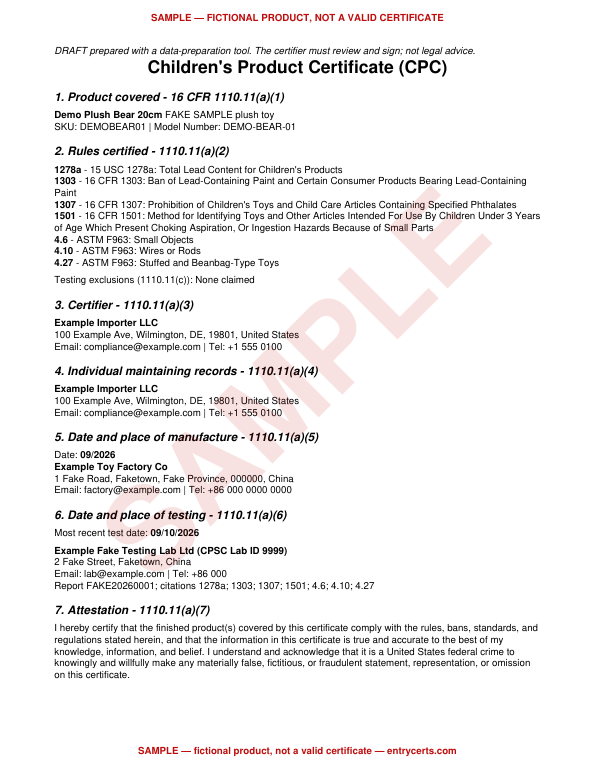
| Section on the sample | What it shows | Where it comes from |
|---|---|---|
| Banner | "DRAFT prepared with a data-preparation tool. The certifier must review and sign." The public sample also says SAMPLE in red on every page. | Every draft we prepare carries the DRAFT line. You issue the final certificate. |
| 1. Product covered | Demo Plush Bear 20cm, SKU DEMOBEAR01, Model Number DEMO-BEAR-01 | Your listing / packing list. The same ID becomes the Registry "Primary Product ID". |
| 2. Rules certified | Seven citation codes, each on its own line with the regulation name: 1278a (lead content), 1303 (lead paint), 1307 (phthalates), 1501 (small parts), and ASTM F963 sections 4.6, 4.10 and 4.27. "Testing exclusions: None claimed". | The test report's scope, written as CPSC's official eFiling citation codes. F963 sections keep their exact form (4.10 is not 4.1). |
| 3. Certifier | Example Importer LLC, full address, email and phone | You, the importer of record. |
| 4. Records custodian | Same company here; can be a person or a staffed position title | You. |
| 5. Manufacture | 09/2026 (MM/CCYY) at Example Toy Factory Co, full address, email and phone | Your factory. Missing factory email or phone is the most common gap. |
| 6. Testing | Last test date 09/10/2026, Example Fake Testing Lab Ltd (CPSC Lab ID 9999, fictional), report number and the codes it covers | The lab test report. |
| 7. Attestation | The 16 CFR 1110.11(a)(7) wording, then a blank signature line with name/title, date and place | You sign. We never sign or certify for you. |
The other three files in the package
Product Registry CSV row
One row in CPSC's bulk-upload template V3 (83 columns, original header names and order), in the format the CPSC Product Registry bulk upload expects. The sample row passes our free CSV validator with 0 errors. The key fields from the sample:
| Column | Sample value |
|---|---|
| Product Update / New Version ID | N / V1 |
| Primary Product ID / Type | DEMOBEAR01 / SKU |
| Certificate Type | CPC |
| Manufacture Date | 09/2026 (MM/CCYY) |
| Lab 1 Type / CPSC-ID | ITL / 9999 (fictional) |
| Lab 1 Citation Codes | 1278a; 1303; 1307; 1501; 4.6; 4.10; 4.27 (semicolons, no commas) |
| Last Test Date | 09/10/2026 (MM/DD/CCYY) |
| POC for Test Result Records | Importer |
Common mistakes in this file are covered in Product Registry CSV upload errors.
Broker sheet
A short text sheet your customs broker can key from. It has the Reference PGA message set fields (your Certifier ID, Product ID and Version ID, once the certificate is in the Registry) and the seven Full PGA data elements: product ID, citation codes, manufacture date and place, test date, lab, and the records contact.
Gap list
Everything missing, inconsistent or in the wrong format in the documents you sent, as a checklist. The sample gap list shows the same fictional bear as if the seller had left out the factory email and phone, the manufacture month, the test date and the records phone, plus items that always need your own check (lab ID and scope, citation codes against the report, your signature). If it is unclear whether a CPC, a GCC or no certificate applies, the gap list says so; we don't decide that for you.
What the sample is not
- It is not a valid certificate. The product, factory, lab, lab ID, importer and people are invented.
- EntryCert is a data-preparation tool. We are not a testing lab, customs broker or law firm, we don't file for you, and we don't guarantee that a product complies or how an entry will clear.
- A real draft is only as good as the test report and details behind it. You (the certifier) review, correct, sign and are responsible for the certificate.
Get the same package for your product
Free first certificate data package — send one product's details and test report. We prepare a DRAFT CPC or GCC, the Registry CSV row, the broker sheet and the gap list. One product per company; no fixed turnaround is promised.
Make it yourself in the generator — runs in your browser; your test report is not uploaded. Drafts are free. Final files without the DRAFT watermark: $19 per SKU, $129 for 10 SKUs, or $29/month unlimited (pricing).
Key dates
- July 8, 2026: eFiling mandatory for imported regulated products (formal and informal entries); new certificate content rules (16 CFR 1110.11) apply to domestic and imported products.
- January 8, 2027: products entered for consumption or warehousing from a Foreign Trade Zone.
- January 20, 2027: international mail shipments filed under CBP's new Entry Type 13.
- There is no de minimis exemption for eFiling. Sources: Final Rule (90 FR 1800), CPSC mail guidance (Oct 2026).
Free tools (they run in your browser; nothing is uploaded):
Free checker — do I need a CPC or GCC? Validate a Product Registry CSV
Free first certificate data package — send one product's details and we prepare a draft CPC or GCC, a Registry CSV row, a broker sheet and a gap list. You review and issue the final certificate. No fixed turnaround is promised.
Customs broker or forwarder handling many client SKUs? Broker plan is $199/month — unlimited SKU unlocks in the Bulk workspace while subscribed, the same entitlement as the Seller plan. EntryCert does not file on your behalf.